
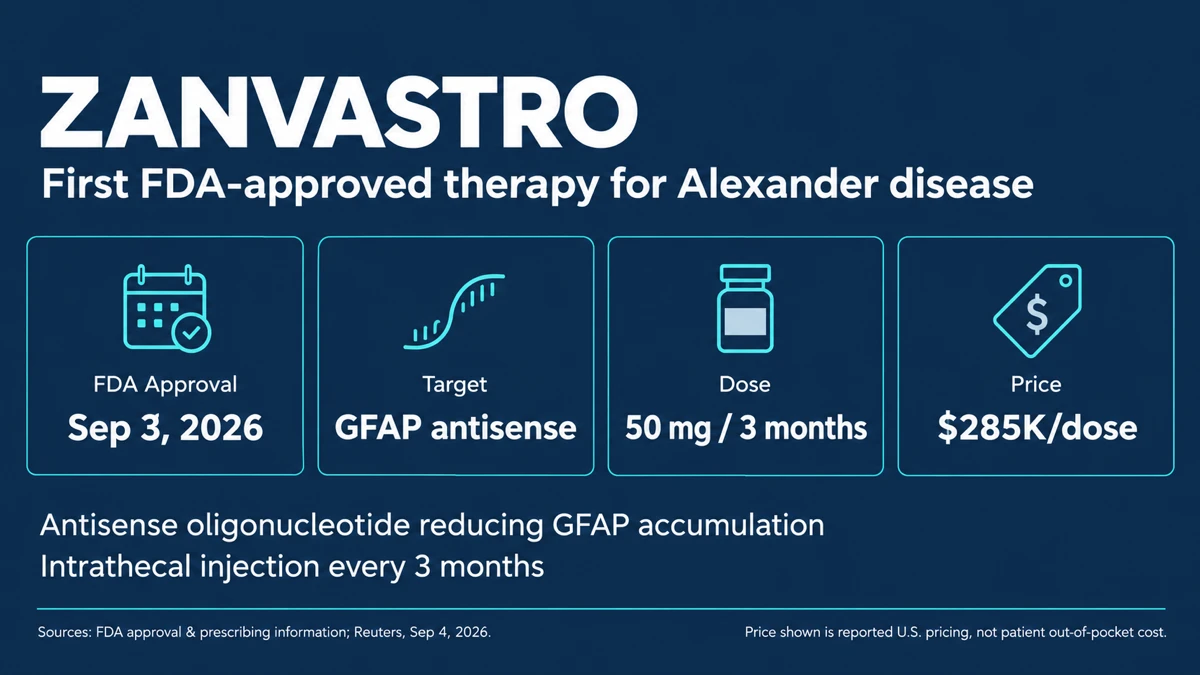
September 3: The First Disease-Modifying Therapy
On September 3, 2026, the U.S. FDA approved Zanvastro (zilganersen) from Ionis Pharmaceuticals as a treatment for Alexander disease — the first disease-modifying therapy for the condition. Until now, patients had no drug that could slow disease progression, only supportive care for symptoms.
Alexander disease is a rare, progressive neurological disorder caused by mutations in the GFAP gene. Abnormal glial fibrillary acidic protein accumulates in astrocytes, forming Rosenthal fibers that destroy neural function. Prevalence is estimated at 1 in 1–3 million, with roughly 300 patients in the United States.
How It Works
Zanvastro is an antisense oligonucleotide targeting GFAP. It reduces production of the abnormal protein before it can accumulate. It is administered intrathecally at 50 mg every three months.
The pivotal trial (NCT04849741) was a multicenter, randomized, controlled study in 49 children and adults aged two and older, plus an open-label sub-study in four children under two. The primary endpoint was gait speed. In patients aged five and older, the Zanvastro group maintained gait speed over 61 weeks while the placebo group declined; in children aged two to four, the treatment group showed broader motor-function improvements. The indication was extended to infants under two based on pharmacokinetic and tolerability data from the four youngest patients.
The FDA granted the application orphan drug, fast track, breakthrough therapy, and rare pediatric disease designations, along with a priority review voucher. The approval caps three decades of research — from foundational work at the University of Wisconsin–Madison through a natural history study launched in 2016 to the clinic.
The Remaining Questions: Price and Access
Behind the approval sit heavy numbers. Ionis set the price at approximately $285,000 per dose — over $1 million per year with quarterly dosing. Access outside the United States remains uncertain. Commercialization ex-U.S. will proceed through a licensing agreement with Italy's Recordati, with regulatory filings in Europe and Japan planned from 2027. Patient groups such as End AxD are calling for accelerated global access.
"Too rare to be ignored" — that is Orphera's message. Zanvastro's approval shows that even ultra-rare diseases can be targets of drug development. But between an approved drug and a patient who can receive it, the gaps of price and access remain. The first treatment is not an ending. It is a beginning.
Based on the FDA approval announcement (September 3, 2026), Nature Biotechnology, "FDA nod for rare neurology drug" (October 12, 2026, doi:10.1038/s41587-026-03349-0), and rareatives.com (October 16, 2026).