
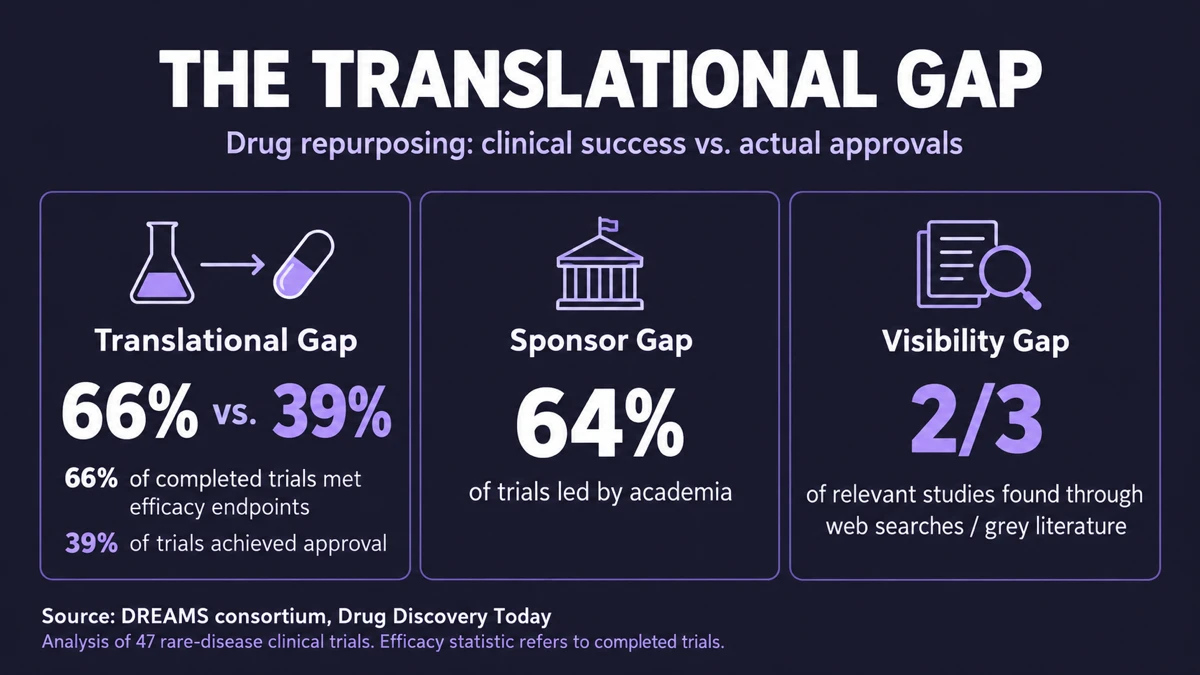
Three Gaps in Drug Repurposing
Drug repurposing is widely considered the most practical strategy for rare-disease drug development. Because the safety profile of an existing drug is already established, repurposing it for a new indication can dramatically cut both development time and cost. Yet a surprising number of repurposing efforts stall even after demonstrating efficacy in clinical trials. Why?
A recent study from the EU-funded DREAMS consortium, published in Drug Discovery Today, confronts this question directly. Analyzing 47 rare-disease drug repurposing trials, the researchers found:
- 66% of completed trials met their efficacy endpoints.
- Only 39% went on to receive marketing authorization from major regulators.
In other words, roughly 4 out of every 10 trials that proved efficacy never crossed the approval threshold. The authors call this the "translational gap" — the distance between clinical evidence and regulatory approval.
The Second Gap: Who Leads the Trial
The study identifies a second gap. Of the 47 trials, 64% were led by academic institutions. Yet industry-sponsored trials were far more likely to reach approval. The researchers term this the "sponsor gap."
Even when academia-led trials demonstrate efficacy, they rarely proceed to a marketing application. Filing for approval demands far more than running a trial — regulatory strategy, supplementary data submissions, post-marketing plans. Academic teams are seldom equipped to carry the entire process. This is a structural reason why valid results end up as journal papers rather than medicines.
The Third Gap: Invisible Evidence
The third is the "visibility gap." In the process of identifying trials for analysis, the researchers found that two-thirds of relevant studies were discoverable only through web searches or grey literature — not through standard databases. The evidence existed, but scattered and unorganized.
Scattered evidence creates two problems. First, researchers miss prior work and repeat redundant efforts. Second, regulators and companies struggle to grasp the full evidence base for a given indication. Invisible evidence is treated much like no evidence at all.
Bridging the Gaps
The DREAMS project (Drug Repurposing with Artificial intelligence for Muscular disorderS), launched in 2023 with EU funding, combines AI and induced pluripotent stem cells to find treatments for rare neuromuscular diseases with no existing therapies. Its targets include dynamin-2 centronuclear myopathy, Duchenne muscular dystrophy, Emery-Dreifuss muscular dystrophy type 2, Pompe disease, and Danon disease, among others.
But as the three gaps show, the bottleneck in drug repurposing is shifting — from finding candidates to connecting evidence to approval. Gathering scattered evidence, translating academic results into industry language, organizing them in the form regulators require. Without this connective work, much of the 66% that proved efficacy will keep stopping at the approval threshold.
Between a successful trial and a drug that reaches patients, there remain gaps yet to be bridged.
Based on the DREAMS consortium study in Drug Discovery Today (2026), the CORDIS press release (October 13, 2026), and the original paper.