
The Bottleneck Was Describing What to Build
The long-standing bottleneck in de novo protein design was not model performance — it was how a design gets started. Existing design models demanded a dedicated input format for every desired property. Translating structural and functional goals into a format the model could understand was itself expert work.
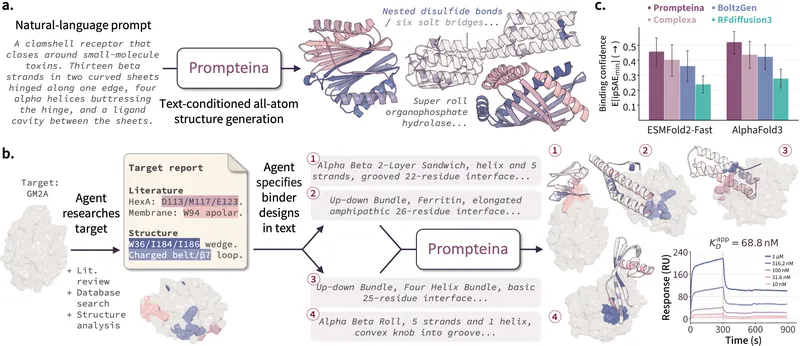
Prompteina, released on arXiv on October 9 by researchers at the University of Washington (David Baker, Hannah Hajishirzi, Wei Pang Ko and colleagues), eliminates that translation step. It is the first model to take natural-language prompts directly and generate full all-atom protein structures. Just as text-to-image models paint scenes from sentences, Prompteina designs proteins from sentences.
1.8 Million Structures, 50 Million Captions
Prompteina stands on Prompteina-Data: 1.8 million protein structures paired with over 50 million captions describing their structural and functional properties at whole-protein and per-residue resolution. The team adapted the existing structure-generation model Proteina-Complexa with text-conditioned pretraining and text–residue alignment fine-tuning.
The numbers are strong. Prompteina beat baselines on 15 of 18 structural properties, and outperformed on binder design for 13 or more of 20 targets. Interface confidence was 14% higher than the strongest baseline, and with iterative in silico feedback, the gains on the hardest targets were 57% larger than non-iterative generation.
Wet Lab: Nine Binders for GM2A
The most striking result goes beyond computational benchmarks. It is the experimental validation on GM2A — a target for which no de novo binder had ever been reported, and for which 30 previous design campaigns had produced zero hits.
Prompteina expressed and measured 89 designs against this target and found nine binders. Six bound at sub-micromolar levels; the strongest showed an apparent dissociation constant (KD) of 107 nM, with the single best measurement at 68.8 nM — affinities taken seriously in early drug discovery.
GM2A is not just a model target. Its deficiency causes GM2 activator deficiency, an ultra-rare disease. A single line of natural language led to binders for a rare-disease target nobody had been able to touch.
The Same Week, Industry Was Already Betting
That same week, Generate Biomedicines and Zealand Pharma announced a deal worth up to $1.2 billion to develop AI-designed protein therapeutics for obesity and metabolic disease (announced October 13, per TechTimes). AI-designed proteins are no longer a laboratory curiosity — they are how big pharma builds pipelines.
From a domain-specific AI perspective, Prompteina poses a clear question. Improving model performance matters, but what changes the bottleneck is who can use that capability, and in what language. When the interface to protein design becomes natural language, design can begin even in areas like rare-disease targets — where data is scarce and experts are few. The essence of domain specialization may ultimately come down to how we treat that interface.
Based on Lee et al., "Designing Protein Structures from Natural Language," arXiv:2610.13917 (posted October 9, 2026; v2 October 13; accepted to NeurIPS 2026), TechTimes reporting (October 14, 2026), and the original abstract.