
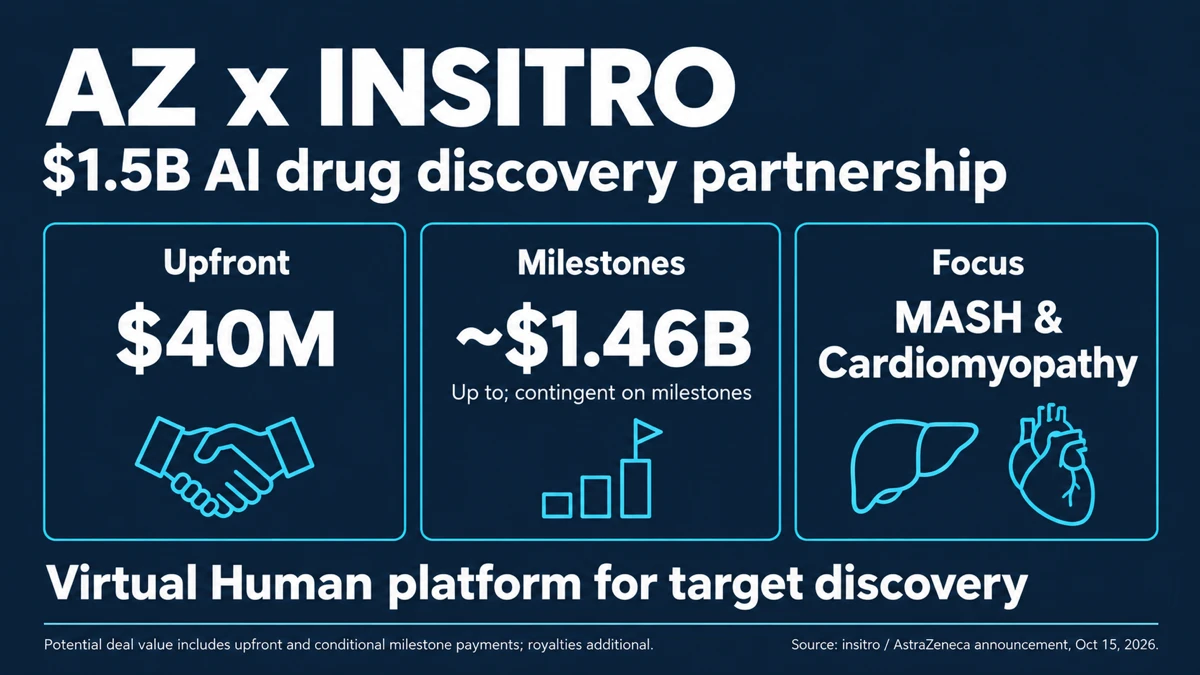
Anatomy of the Deal
On October 15, AstraZeneca and insitro announced a multi-year strategic collaboration: $40 million upfront, up to approximately $1.46 billion in development and commercial milestones, plus single-digit royalties. The focus: metabolic dysfunction-associated steatohepatitis (MASH) and cardiomyopathies.
The division of labor is crisp. insitro will use its Virtual Human platform to elucidate causal disease biology and advance AZ-nominated targets to development-candidate stage. AZ takes over from there — clinical trials, regulatory work, commercialization. In short: the AI company finds the targets, big pharma makes the drugs.
Why MASH and Cardiomyopathies
The two disease areas share one trait: their causes are unknown. MASH is a severe liver disease; cardiomyopathies are a family of disorders affecting heart muscle. Both lack effective treatments precisely because their fundamental biological drivers have been hard to pin down. insitro's Virtual Human combines lab-grown cellular models with machine learning to find causal disease biology — and the less known the cause, the more valuable the ability to narrow causality with data becomes.
As Sharon Barr, AZ's head of biopharmaceuticals R&D, told Reuters: "One of the hardest things we do in R&D is choosing new targets to put into the discovery pipeline." What big pharma wants from AI is not the model itself — it is the ability to pick targets for the pipeline.
TechBio's Expanding Footprint
This deal is not insitro's only move. The company recently expanded its partnership with Bristol Myers Squibb to broaden an ALS target portfolio, and with Eli Lilly it is building AI models to predict the in vivo pharmacology of small molecules (Lilly's TuneLab, disclosed October 6). TechBio companies are pushing deeper into big pharma's discovery pipelines, and the trend is accelerating.
From a foundry perspective, what this deal signals is clear. What pharma is betting on in AI is not "model development" per se — it is the target-discovery pipeline. The value of domain-specific AI is measured not in papers, but in the number of targets that actually enter pipelines. Orphera's Foundry will ultimately be judged by the same standard.
Based on insitro's official announcement (October 15, 2026) and Reuters reporting (October 15, 2026, Patrick Wingrove).